What Ancient Glass Reveals About Civilization
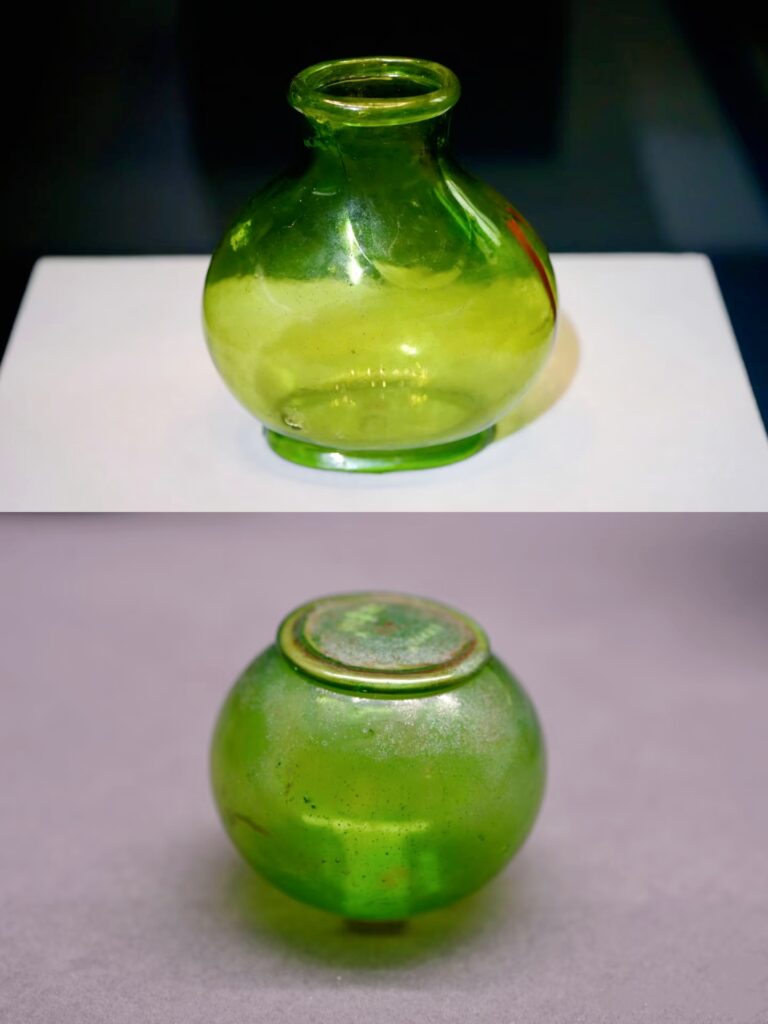
Do you remember the necklace I introduced before — the one that belonged to Li Jingxun, a nine-year-old girl from the Sui dynasty? Today, I want to talk about another group of objects found in her tomb: glassware.
At first glance, these two glass objects look almost the same. But in fact, they represent two completely different glass-making traditions. The bottle above is made of soda-lime glass, while the jar below is made of lead-barium glass.
Glass was first made in the Near East, in Mesopotamia, about 4,000 years ago. From there, glass-making technology spread westward to the Mediterranean world and eastward toward China. In China, some of the earliest known glass objects date back to the Western Zhou period.
The key ingredient of glass is silicon dioxide, the main component of quartz sand. But silicon dioxide has a very high melting point — about 1,700 degrees Celsius. For ancient craftsmen, reaching such a temperature was extremely difficult. So they found another solution: they added fluxes, materials that could lower the melting temperature.
In the Near East and the Mediterranean world, craftsmen used natural soda as a flux. Together with the calcium naturally found in sand, this created the soda-lime glass tradition. This type of glass was harder to produce, but it was more stable and more transparent.
China took a different route. Natural soda was not widely available, but lead was. China also had a long tradition of bronze-making and metalworking. Lead could lower the melting temperature and make the material flow more easily. Chinese craftsmen applied this knowledge to glass-making and developed a distinctive type of glass: lead-barium glass.
Lead-barium glass was easier to make because it required a even lower temperature. But compared with soda-lime glass, it was usually less stable and less transparent. Today, its chemical makeup is an important clue for archaeologists when they try to determine whether an ancient glass object was made locally in China.
The two glass objects from Li Jingxun’s tomb show this contrast very clearly. The more transparent bottle is made of soda-lime glass, so archaeologists believe it was probably imported through the Silk Road. Historical records also show that from the Han dynasty onward, glassware imported from the West became a luxury item among aristocratic families. The less transparent jar, however, belongs to China’s own lead-barium glass tradition.
We should never underestimate glass-making technology. Later, the development of high-quality glass in the West helped improve optical lenses. Telescopes allowed humans to look deep into the universe, while microscopes opened the door to the invisible world of cells and microorganisms. Because of differences in materials and technological paths, China did not develop an equally advanced optical glass system for a long time. This, to some extent, limited the progress of astronomy, medicine, and biology in the early modern period.
So you see, these two small glass objects matter not only because they are beautiful or because they once belonged to an important historical figure. They matter because they tell a much larger story — a story about resources, technology, choices, and the different paths of human civilization.
여러분, 제가 전에 소개했던 수나라 시대 9살 소녀 이정훈의 목걸이 기억하시나요? 오늘은 그녀의 무덤에서 나온 또 다른 유물, 바로 유리 제품에 대해 이야기해 보려고 합니다.
처음 보면 이 두 유리 제품은 거의 비슷해 보입니다. 그런데 사실은 서로 전혀 다른 유리 제작 방식을 보여주고 있습니다. 위에 있는 유리병은 소다석회유리이고, 아래에 있는 유리 항아리는 납바륨유리입니다.
유리는 약 4,000년 전, 메소포타미아를 중심으로 한 근동 지역에서 처음 만들어졌다고 알려져 있습니다. 이후 유리 제작 기술은 서쪽으로는 지중해 세계로, 동쪽으로는 중국으로 전해졌습니다. 중국에서도 서주 시대의 초기 유리 유물들이 발견되고 있습니다.
유리의 가장 중요한 성분은 이산화규소, 즉 석영 모래의 주성분입니다. 그런데 이산화규소는 약 1700도 정도의 아주 높은 온도에서 녹기 때문에, 고대에는 녹이기가 매우 어려웠습니다. 그래서 장인들은 한 가지 방법을 생각해냈습니다. 바로 녹는 온도를 낮춰 주는 물질, 즉 융제를 넣는 것이었습니다.
근동과 지중해 지역에서는 천연 탄산나트륨을 융제로 사용했습니다. 여기에 모래 속 칼슘 성분이 더해지면서 소다석회유리 제작 기술이 만들어졌습니다. 이 방식의 유리는 만들기는 어려웠던 대신 화학적으로 안정적이고 투명도도 높았습니다.
반면 중국은 조금 다른 길을 걸었습니다. 중국에는 천연 탄산나트륨이 풍부하지 않은 대신, 납 자원이 비교적 풍부했고 이미 청동 제작 기술도 발달해 있었습니다. 납은 녹는 온도를 낮추고 재료가 더 잘 흐르게 해주는 역할을 합니다. 그래서 중국 장인들은 이 금속 가공 경험을 유리 제작에 활용했고 납바륨유리라는 독특한 유리 기술을 발전시켰습니다.
납바륨유리는 더 낮은 온도에서 만들 수 있어서 제작이 비교적 쉬웠습니다. 하지만 소다석회유리에 비하면 안정성과 투명도는 다소 떨어졌습니다. 오늘날에는 이런 성분 차이가 고대의 유리 제품이 중국에서 제조된 것인지를 판단하는 중요한 단서로 활용되고 있습니다.
이정훈의 무덤에서 나온 두 유리 유물은 바로 이 차이를 잘 보여줍니다. 더 투명한 유리병은 소다석회유리로 만들어졌기 때문에 실크로드를 통해 들어온 수입품으로 추정됩니다. 역사 기록을 보면 한나라 이후 서역에서 들어온 유리 제품은 귀족들이 과시용으로 사용하던 사치품이었습니다. 반면 투명도가 낮은 유리 항아리는 중국 고유의 납바륨유리로 제작된 것입니다.
유리 제작은 절대 가볍게 볼 수 있는 기술이 아닙니다. 서양에서는 이후 고품질 유리가 발전하면서 광학 렌즈 기술이 크게 발전했습니다. 그 결과 망원경은 인류가 더 먼 우주를 볼 수 있게 해주었고, 현미경은 눈에 보이지 않는 미시 세계를 열어주었습니다. 재료와 기술 경로의 차이 때문에 중국은 오랫동안 서양과 같은 광학 렌즈 기술을 발전시키지 못했습니다. 이것은 근대 초기 중국의 천문학, 의학, 생물학의 발전에도 영향을 주었습니다.
유리로 제작된 이 두 개의 작은 유물이 가지는 의미는 단순히 아름답다거나 유명인사의 무덤에서 나왔다는 것이 아닙니다. 이 유물들이 정말 중요한 이유는 그 안에 자원을 바탕으로 발전해 온 기술과 그에 따라 인류 문명이 걸어왔던 서로 다른 방향의 길에 대한 이야기를 담고 있기 때문입니다.
